
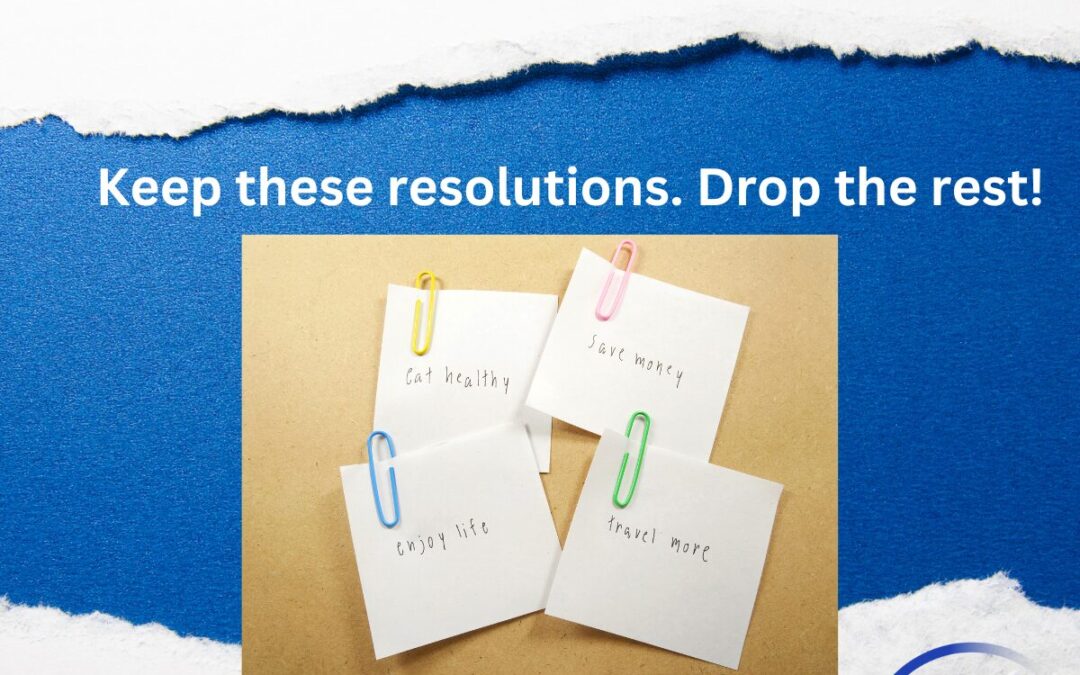
By the time mid-January rolls around, I’ve usually already abandoned a few resolutions. Quietly, intentionally, without guilt. Not because I lack discipline, but because experience has taught me something most professionals won’t admit out loud: many resolutions sound responsible yet actively work against the life and leadership we’re trying to build!
End-of-year clarity doesn’t come from doubling down. It comes from noticing what we’ve already stopped forcing and why. That awareness is far more important than any list I’ve written down and checked off between client meetings and holiday obligations.
As I step into 2026, here’s what I’ve learned about setting goals that actually stick and the ones that deserve to be dropped early.
DON’T: Commit to Goals That Perform Well on Paper
If a goal looks impressive but doesn’t change how you think, decide, or behave, it’s not a goal, it’s performative. Professionals are especially good at creating objectives that signal ambition without requiring internal shifts.
If the goal doesn’t force a trade-off, it won’t force growth. And if it doesn’t require you to say no to something familiar, it’s probably not real.
DO: Choose Objectives That Reshape Your Calendar
The most honest place to find your priorities isn’t your vision board, it’s your schedule. Goals that matter will demand different use of time, energy, and attention. When you do this, some of the things on that vision board actually can come true!
Before committing to anything for 2026, ask: What will this goal replace? If the answer is nothing, for me it won’t survive February.
DON’T: Set Targets Based on Who You Used to Be
Many resolutions fail because they’re written for an earlier version of ourselves, one with different capacity, context, or constraints. Growth changes the game, yet we often keep playing by outdated rules.
If your goal relies on stamina, tolerance, or motivation that you no longer have, or in my case, or no longer want, it’s already expired.
DO: Align Goals With Who You’re Becoming
The strongest goals feel slightly unfamiliar because they’re designed for who you’re evolving into, not who you were. Read that again. They require new skills, different boundaries, and more discernment.
These goals don’t scream urgency. They whisper alignment and that’s why they last.
DON’T: Use Discipline to Compensate for Misalignment
White-knuckling your way through a goal is a warning sign, not a virtue. When something consistently requires force, the issue isn’t effort, it’s not the right fit.
Professionals often mistake perseverance for wisdom. Sometimes the smarter move is to stop trying to make the wrong goal work harder.
DO: Design Systems That Make Progress Inevitable
The goals that stick aren’t always powered by motivation. They’re supported by structure. Simple systems, one that have clear decision rules, default behaviors, environmental cues, do the heavy lifting when willpower fades.
If success depends on you trying harder, the system is broken.
DON’T: Confuse Momentum With Direction
Activity often times feels productive, especially at the start of the year. But motion without intention creates exhaustion, not results. Many resolutions fail because they accelerate what shouldn’t be moving at all.
Speed amplifies direction. If you’re unclear where you’re headed, moving faster just gets you there sooner.
DO: Define What ‘Enough’ Looks Like
One of the most powerful decisions you can make for 2026 is deciding where you will stop. Growth without a ceiling becomes a moving target and a chronic source of dissatisfaction.
Clear definitions of enough protect focus, energy, and credibility. They also free you from constantly chasing the next marker of success. So ask yourself, “How much is enough”?
DON’T: Wait for Clarity Before Acting
Clarity often follows action, not the other way around. Professionals delay goals waiting for certainty that never arrives and then blame timing when the year slips away.
Progress doesn’t require confidence. It requires commitment to learn as you go.
DO: Make Peace With Imperfect Execution
The professionals who make the most meaningful progress aren’t the most precise, they’re the most consistent. They adjust quickly, reflect often, and keep moving without dramatizing missteps.
Perfection slows momentum. Progress rewards forward momentum.
DON’T: Carry Goals That No Longer Belong to You
Some goals are inherited: from organizations, mentors, family expectations, or earlier seasons of survival. Holding onto them out of loyalty quietly drains your authority.
If a goal no longer reflects your values, releasing it isn’t failure, it’s self-awareness and leadership.
DO: Let 2026 Be Built on Subtraction
The most effective resolutions I’ve ever kept weren’t about adding more. They were about removing friction, noise, and unnecessary obligation.
When you decide what you don’t want to come with you into this year, what remains has room to grow.
As the year closes, the real question isn’t “What should I commit to next”? “It’s what have I already outgrown and am finally ready to admit”? Those answers is where 2026 actually begins!
I want to hear from you. Please like, comment, or share in the comments below. As always, I appreciate you reading.
#Leadership #ExecutivePresence #ProfessionalGrowth #YearEndReflection