
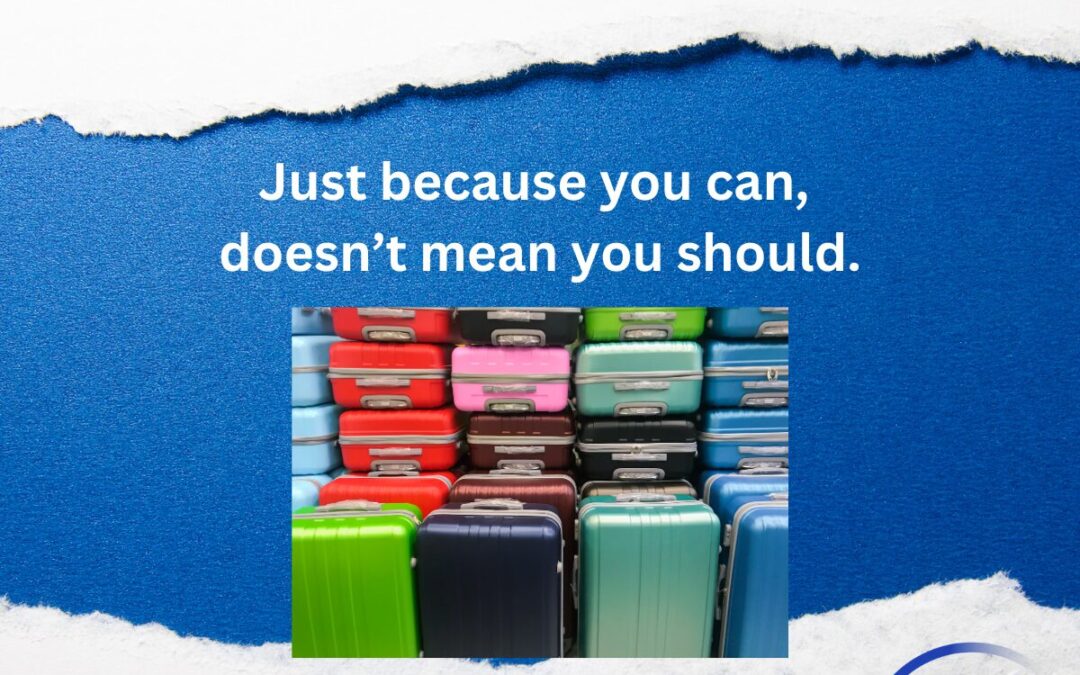
Picture this. I was in Costa Rica deep in a Shaman ceremony and I had the most profound dream. I was standing under a large jet plane, loading heavy luggage onto a conveyor belt. It seemed like hundreds of people were dropping their bags before they climbed up the steps to board the plane. I was smiling at them at first, and then as I became wearier and sorer from lifting, I started to get mad. Yet, I kept doing it. After all, I was helping and I thought this was my job! This dream went on forever, and I questioned why it wasn’t the luggage wouldn’t stop coming. A voice then said to me, “Why aren’t you having these people load their own luggage, it is not yours to carry’. Mind blown. Then I said out loud, “Everyone can carry their own damn luggage, I’m not doing it anymore!” It was at that point that I woke up. Literally and figuratively.
One of the things I’ve had to learn, and honestly, relearn throughout my life and career, is that just because I can solve a problem doesn’t mean I should. That sounds simple, but for high performers like me, it’s really difficult.
Many of us built our careers by being helpful, resourceful, and willing to jump in when something needed attention. We became the people others could count on. We carried the heavy loads. The problem is that over time, that strength can quietly become a habit. And eventually, that habit can become a distraction.
Before we know it, we’re spending enormous amounts of energy solving problems nobody actually asked us to solve, carrying responsibilities that belong to someone else, and wondering why we feel busy but not necessarily productive.
I’ve noticed that some of the most capable professionals aren’t struggling because they’re doing too little. They’re struggling because they’re doing too many of the wrong things.
Usefulness
There is a subtle reward system built into most organizations. The person who steps in gets recognized. The person who fixes things becomes valuable. The person who saves the day develops a reputation for reliability.
Over time, that reinforcement can create an addiction to usefulness. The challenge is that usefulness and impact are not always the same thing. In fact, some professionals spend years becoming incredibly useful while slowly moving further away from the work that creates their greatest value.
They’re solving operational problems when they should be thinking strategically. They’re answering questions that others should learn to answer themselves. They’re stepping into situations that would likely be resolved without them.
Being needed feels good. But there comes a point when being useful starts getting in the way of being effective.
Ownership
One of the most common leadership challenges I see is taking ownership of outcomes that don’t actually belong to you. Someone misses a deadline, and you feel responsible. A colleague struggles, and you immediately begin figuring out how to help. A team member encounters a challenge, and before they have a chance to work through it, you’re already trying to solve it for them. At first glance, this looks supportive. But sometimes what we call support is actually control disguised as helpfulness.
When we consistently remove other people’s opportunities to struggle, think, learn, and adapt, we unintentionally limit their growth while increasing our own workload. Not every problem requires your intervention. Some problems require someone else’s development. It’s not up to you to carry someone else’s luggage!
Motion
One of the most deceptive feelings in professional life is the feeling of progress. Activity feels productive. Solving things feels productive. Checking boxes feels productive. But motion and progress are not always traveling in the same direction.
I’ve worked with leaders who spend entire days extinguishing small fires only to discover that none of those efforts moved the organization forward. They were busy. They were exhausted. They were constantly engaged. They were also spinning their wheels. The question isn’t simply, “Am I working hard?” The better question is, “Am I working on the right thing?”
Capacity
Many professionals believe they’re overwhelmed because they have too much responsibility. Sometimes that’s true. But sometimes the real issue is that they’ve accepted responsibility they were never meant to carry.
Every unnecessary problem you adopt consumes attention, energy, and decision-making capacity. It takes space that could have been invested elsewhere. The danger isn’t simply burnout. The danger is opportunity cost. Every hour spent solving someone else’s problem is an hour not spent advancing your own priorities, developing your team, or focusing on the work only you can do. The most effective people are not always the busiest people in the room. They’re often the clearest about what belongs to them and what doesn’t.
Trust
At its core, taking on too much often comes back to trust. Trust that others are capable. Trust that mistakes can be valuable teachers. Trust that every challenge doesn’t require your immediate involvement. Trust that the world won’t fall apart if you step back occasionally.
This is especially difficult for leaders because stepping in feels responsible. Stepping back can feel uncomfortable. But leadership isn’t measured by how many problems you solve personally. It’s measured by how many people become capable of solving problems without you.
Discernment
The professionals who create the greatest long-term impact develop a skill that doesn’t get talked about nearly enough. Discernment: the ability to distinguish between what deserves their attention and what simply demands it.
Repeat after me. Not every issue deserves escalation. Not every obstacle deserves intervention. Not every problem deserves ownership. Make this your mantra! Just because something crosses your desk doesn’t mean it belongs on your shoulders.
The Real Question
I’ve learned that some of the most important professional growth doesn’t come from learning what to take on. It comes from learning what to leave alone. Because the goal isn’t to become the person who solves everything. The goal is to become the person who focuses on the things that matter most. Because sometimes the most productive thing you can do is stop solving problems that were never yours to solve in the first place.
I want to hear from you. Does any of this resonate with you? If so, what are you picking up that you should be putting down? Where can you spend more time on the things that actually help you grow professionally? Please like, comment, or share this article with anyone you think might enjoy it. As always, I appreciate you reading.
#Leadership #ProfessionalGrowth #ExecutivePresence #LeadershipDevelopment